

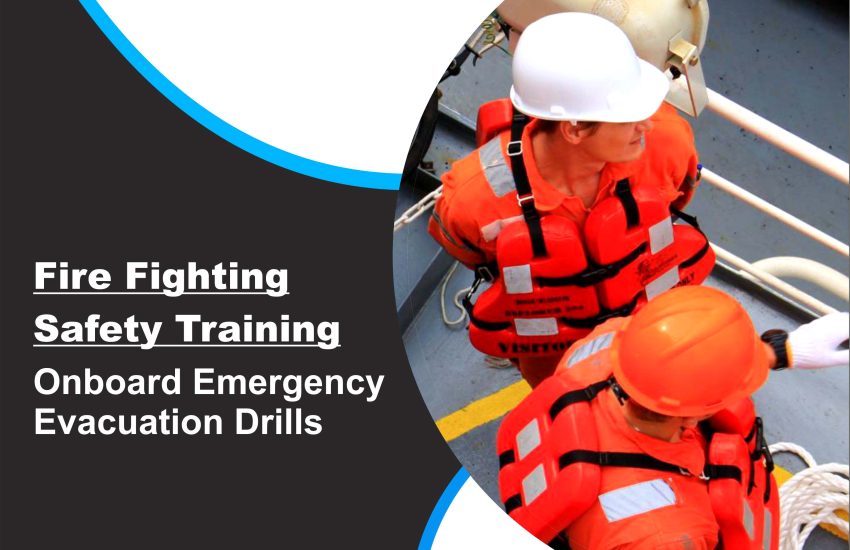
Onboard Emergency Evacuation Drills. In the maritime industry, safety is not optional—it’s mandatory. Onboard emergency evacuation drills are a core part of ensuring that crews are well-prepared for real-life emergencies. Among these drills, fire drills at sea stand out as one of the most revealing and critical exercises. They offer a clear picture of how effectively a crew can respond under simulated emergency conditions.
This article explores the significance of onboard fire drills, their structure, and how they serve as essential tools for evaluating crew readiness, identifying procedural gaps, and enhancing overall vessel safety.
The Purpose of Onboard Emergency Evacuation Drills
While training equips the crew with essential emergency procedures, evacuation drills test the crew’s ability to apply those procedures under pressure. These drills simulate real-life emergencies such as onboard fires, chemical leaks, collisions, or abandon ship scenarios. They serve as full-scale rehearsals that bring theoretical training into action.
During a fire drill, for example, crew members gear up, coordinate in teams, activate communication systems, and follow chain-of-command protocols—just as they would in a real emergency.
The Fire Drill: A Stress Test of Safety
According to Vincent Coquelet, HSE Corporate Manager, “Drills show how long it takes the crew to gear up and become operational. This helps measure the effectiveness of training.” If a fire drill reveals slow response times, procedural misunderstandings, or equipment failures, these red flags indicate a need for further emergency response training.
Moreover, fire drills allow safety officers to:
- Assess coordination among fire brigades, medical teams, and bridge personnel
- Evaluate communication lines between the bridge and external support (e.g., the Designated Person Ashore (DPA), nearby vessels)
- Identify delays in evacuation or medical intervention
- Test fire suppression equipment under simulated conditions
Real-World Simulation: Aboard the Bourbon Liberty 247
Consider a recent fire drill conducted on the Bourbon Liberty 247, an offshore supply vessel. Following the simulated alarm:
- The roll call confirmed that all crew members were present, indicating no injuries.
- The crew split into four teams: the main fire brigade, backup fire brigade, a medical team, and the bridge team.
- While the fire brigade prepared to enter the compartment affected by the simulated fire, the bridge team alerted the DPA and HSE Manager, seeking additional fire support and medical backup.
This high-level coordination mimicked the operational requirements of an actual emergency. The goal was not only to fight the fire but also to test every layer of the ship’s emergency response system.
Importance of Debriefing After the Drill
Every fire drill ends with a comprehensive debriefing session, led by the ship’s captain and safety officers. This session provides:
- A full review of the crew’s performance
- An analysis of communication and response times
- Identification of any technical or procedural malfunctions
- Recommendations for future safety training sessions
As Vincent Coquelet emphasizes, “If a drill reveals malfunctions, imagine what would happen under the real pressure of an emergency. Debriefing is essential to identify and correct these weaknesses.”
Why Drills Are Essential for Maritime Safety
Conducting regular onboard evacuation drills is not just a regulatory requirement—it’s a life-saving necessity. These drills:
- Prepare crew members to respond with speed and precision
- Reinforce team coordination and role clarity
- Ensure that all safety systems are functional
- Support compliance with international maritime safety standards like SOLAS (Safety of Life at Sea)
- Provide a benchmark to continuously improve HSE (Health, Safety, and Environment) practices
In essence, drills transform training theory into practical execution, building a culture of safety on board.
Conclusion
Onboard emergency evacuation drills, especially maritime fire drills, offer critical insights into a vessel’s preparedness for emergencies. They expose weaknesses in response systems, reveal training gaps, and validate the crew’s operational readiness. As shown on the Bourbon Liberty 247, the success of a drill lies not just in execution but in the lessons learned during the debrief.
