




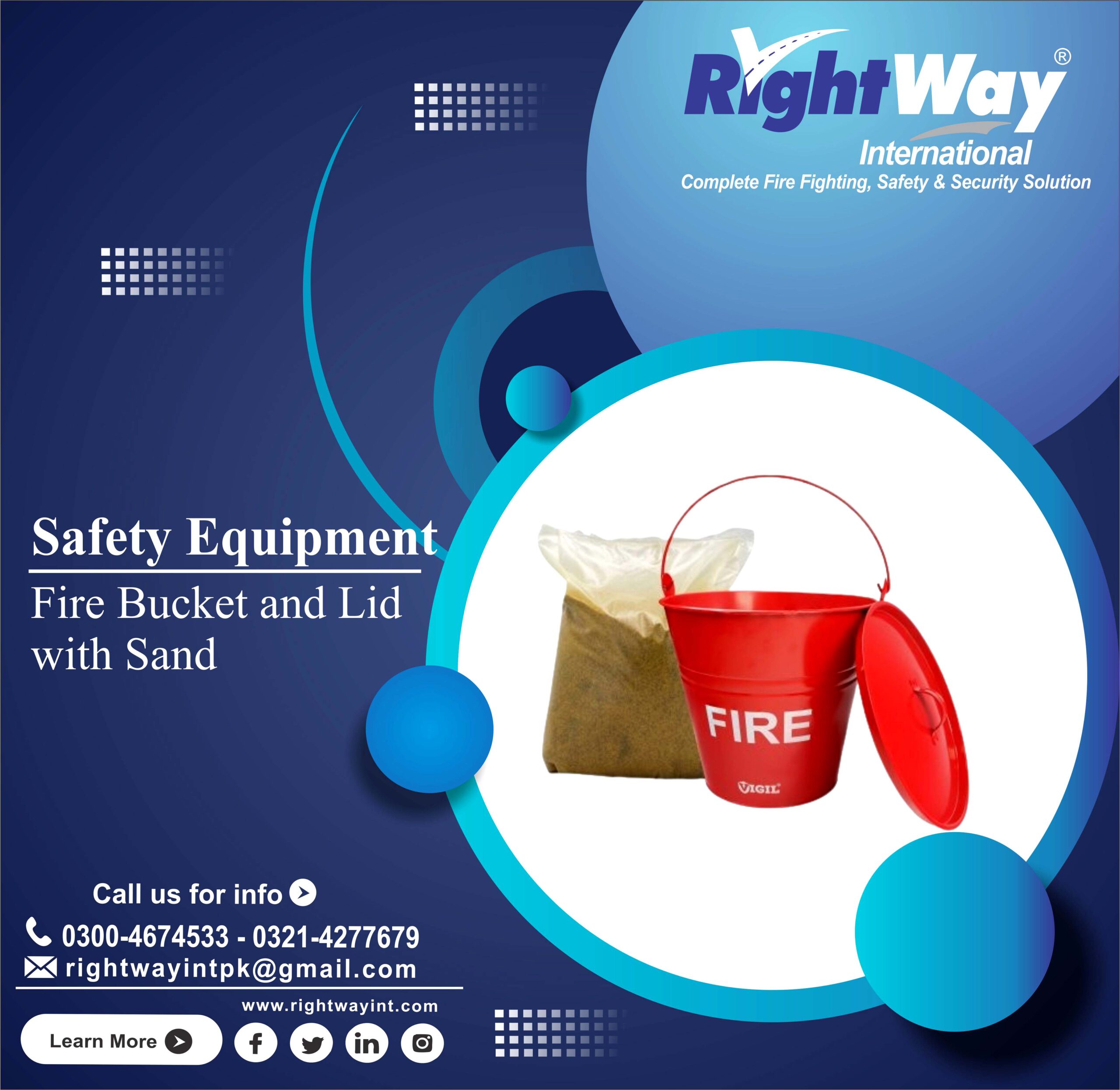
Fire Bucket Types Uses & Price in Pakistan. fire bucket is one of the simplest yet highly reliable fire safety tools used to control small fires, especially in emergency situations. It is commonly filled with sand or water and works by either smothering flames (sand) or cooling the fire (water).
Fire buckets are widely used across Pakistan in factories, petrol pumps, warehouses, construction sites, schools, and public buildings, particularly in major cities like Karachi, Lahore, Islamabad, Faisalabad, Multan, and Peshawar due to increasing fire safety awareness. as Per National Fire Protection Association.
What Is a Fire Bucket?
A fire bucket is a durable container (usually metal or plastic) designed to hold fire-extinguishing materials such as:
- Sand (for oil and electrical fires)
- Water (for general fires like wood or paper)
It is typically painted bright red with the word “FIRE” clearly marked for quick identification during emergencies.
Purpose of Fire Buckets
- Extinguish small fires quickly
- Control fire spread
- Provide immediate response before advanced equipment arrives
- Act as backup when extinguishers are unavailable
Common Components of a Fire Bucket
? Bucket Body – Made from galvanized steel or heavy-duty plastic
? Handle/Grip – For easy carrying and quick use
? Wall Stand/Bracket – For proper mounting and accessibility
? Fire Marking – Red paint with “FIRE” label for visibility
Common Usage Areas
Fire buckets are commonly found in:
- Petrol pumps
- Industrial factories
- Construction sites
- Warehouses
- Parking areas and garages
- Schools and offices
- Residential buildings
Key Features of Fire Buckets
✔ Simple & Cost-Effective
Very affordable compared to other fire equipment
✔ Instant Use
No training required—just throw sand or water
✔ Low Maintenance
Minimal upkeep needed
✔ Reliable Backup
Works even if extinguishers fail
✔ Multi-Purpose
Can be used for different fire types depending on filling material
Types of Fire Buckets
1️⃣ Sand Fire Bucket
Features:
- Filled with dry sand
- Most commonly used type
Uses:
- Oil fires
- Electrical fires
- Fuel spills
? Price: PKR 800 – 2,000
2️⃣ Water Fire Bucket
Features:
- Filled with water
- Simple and economical
Uses:
- Paper fires
- Wood fires
- Cloth fires
? Price: PKR 500 – 1,500
3️⃣ Metal Fire Bucket
Features:
- Made from galvanized iron or steel
- Heat-resistant and durable
Uses:
- Industrial environments
- Outdoor applications
? Price: PKR 1,000 – 2,500
4️⃣ Plastic Fire Bucket
Features:
- Lightweight and corrosion-resistant
- Easy to handle
Uses:
- Offices
- Indoor areas
? Price: PKR 500 – 1,200
5️⃣ Mounted Fire Bucket Set
Features:
- Comes with wall stand
- Multiple buckets in one setup
Uses:
- Factories
- Petrol stations
- Large facilities
? Price: PKR 3,000 – 8,000 (set)
Main Uses of Fire Buckets
Fire buckets are essential for:
✅ Controlling small fires quickly
✅ Handling flammable liquid fires (with sand)
✅ Preventing fire spread
✅ Emergency response in workplaces
✅ Backup fire safety solution
✅ Supporting evacuation safety
Importance in Pakistan
Fire buckets play a critical role in Pakistan due to:
- Frequent industrial and electrical fires
- Limited access to advanced fire systems in small businesses
- Low cost and easy availability
- Mandatory safety requirements in many industries
They are especially useful in areas where fire extinguishers are not maintained or readily available.
Fire Bucket Price in Pakistan
| Type | Estimated Price (PKR) |
|---|---|
| Plastic Bucket | 500 – 1,200 |
| Metal Bucket | 1,000 – 2,500 |
| Sand Bucket (Filled) | 800 – 2,000 |
| Water Bucket | 500 – 1,500 |
| Bucket Stand Set | 3,000 – 8,000 |
Prices vary based on material, size, thickness, and quality.
Other Fire Safety Equipment Used With Fire Buckets
Fire buckets are part of a complete fire protection system, including:
? Fire Extinguishers – For larger and more dangerous fires
? Fire Blankets – For smothering flames and protecting people
? Fire Safety Helmets – Head protection during fire response
? Fire Safety Gloves – Heat-resistant hand protection
? Firefighting Suits – Full-body protection from heat
? Fire Boots – Heat-resistant footwear
? Breathing Apparatus (SCBA) – Protection from smoke inhalation
? Smoke Detectors – Early fire detection
? Fire Alarm Systems – Alert occupants quickly
How to Use a Fire Bucket
Step 1 – Identify Fire Type
- Use sand for oil/electrical fires
- Use water for general fires
Step 2 – Take the Bucket
Grab the bucket quickly from its stand
Step 3 – Throw Contents
Throw sand or water directly onto the fire
Step 4 – Repeat if Needed
Use multiple buckets if the fire continues
Step 5 – Call Emergency Services
Always inform fire brigade for safety
Maintenance Tips
✔ Keep buckets filled at all times
✔ Use dry sand (no moisture)
✔ Place in visible and accessible locations
✔ Inspect regularly for damage or rust
✔ Refill immediately after use
FAQs
1. What is a fire bucket used for?
It is used to extinguish small fires using sand or water.
2. Which is better: sand or water bucket?
Sand is safer for oil and electrical fires, while water is for general fires.
3. Is a fire bucket enough for safety?
No, it should be used along with other fire safety equipment.
4. Where should fire buckets be placed?
Near fire-risk areas like kitchens, fuel storage, and machinery.
5. What is the average price in Pakistan?
Around PKR 500 to 2,500, depending on type and quality.